
Call Center Experience!
by ivank123

/50daabd0c626da5fb36056ae9d9f0246.jpg)
/84fc57ca54fd1eaec4efddd55ce83a6b.jpg)
/f97d47f0ec76e0fe57c2c0c03cafc834.jpg)
/85a7f99cad874310702afe45eed5e649.jpg)
/2108a24c6e02038e3dc1acb4d4371cf6.jpg)
/6b036162cc89b101f0813468be2c7081.jpg)



.jpg)
.jpg)
.jpg)
.jpg)
.jpg)
.jpg)
Files
This work has been commented by 3 curator(s). Read the comments
Title
Call Center Experience!
Headline
Contact cente emulator
Concept author(s)
Ivan Kozenitzky
Concept author year(s) of birth
13/09/1978
Concept author(s) contribution
General idea, texts, design and artwork.
Concept author(s) Country
Argentina
Designer(s)
Anibal Pérez
Designer(s) contribution
Ideas, design, text corrections.
Designer(s) Country
Argentina
Other author(s)
Anibal Pérez, Ana Thompson
Other author(s) contribution
Ideas, voices, translations, photography.
Other author(s) Country
Argentina
Friendly Competition
Competition category
Mobilization
Competition field
nonacademic
Competition subfield
professional
Subfield description
I'm an architect and web designer, I work in both disciplines
Check out the Debt. 2012 outlines of Memefest Friendly competition.
Description of idea
Describe your idea and concept of your work in relation to the festival outlines:
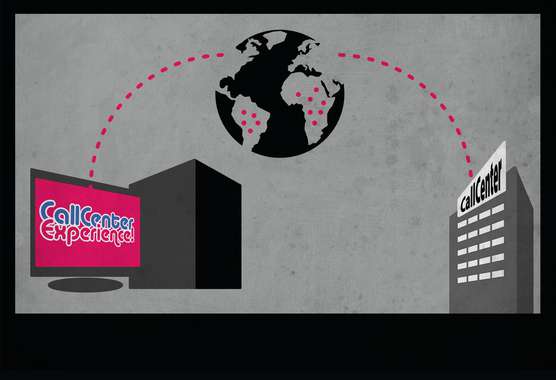
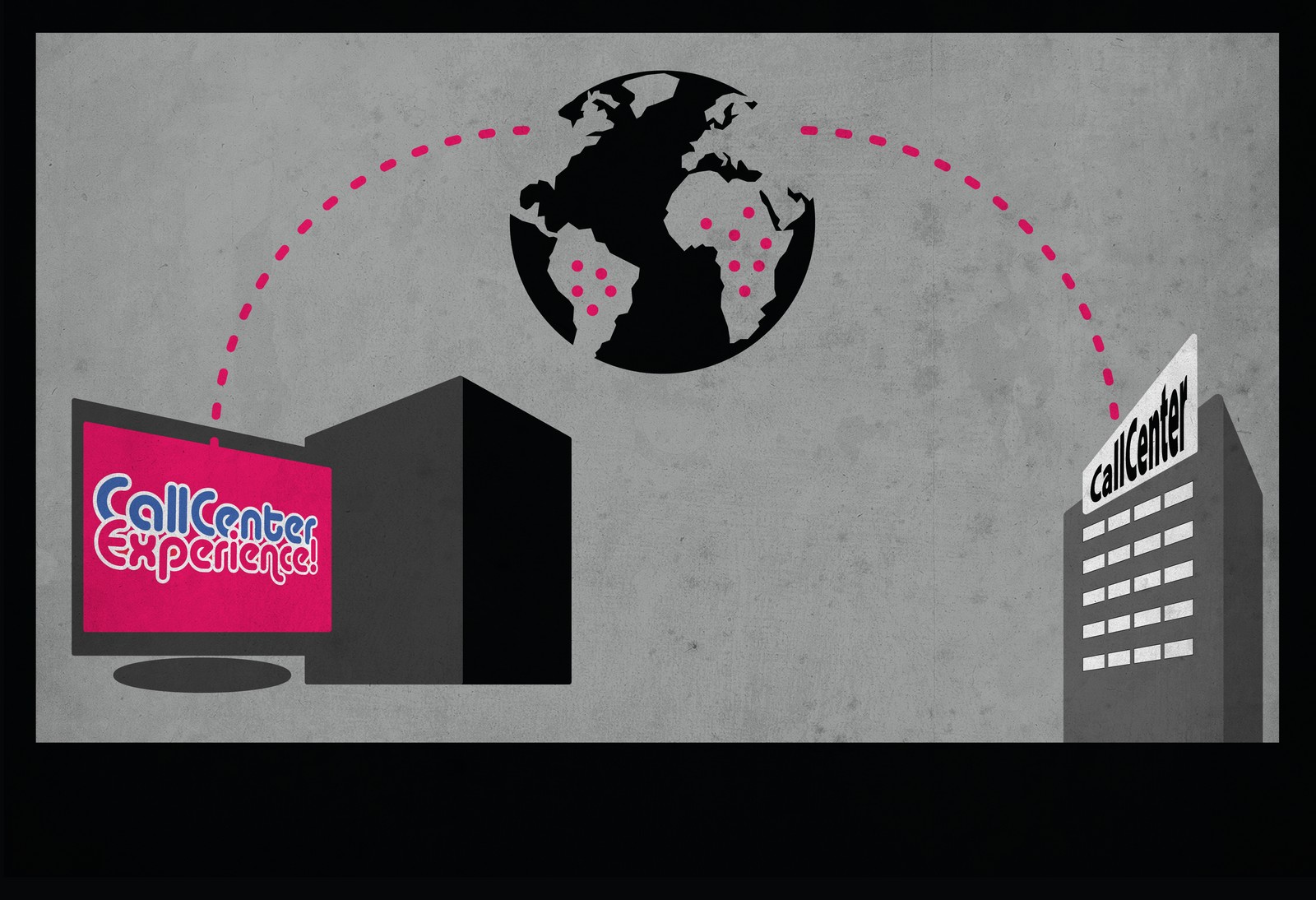
Whenever a customer calls a very important company´s 1-800 number the call is answered by a teleoperator being miles away, working for an outsourcing company. These companies are known as call centers.
Call centers are companies that use new communication technologies to employ workers residing in countries where salaries are low. Eventhough there are many companies providing outsourcing services, they all look alike. They sell a youthful, casual image associated with advanced technologies and values such as freedom and dynamism.
Nevertheless none of the above is so. As a result of this relocation call center operators, usually speaking a foreign language, hide their true location and identity. These workers are trained to keep call control through a series of rules and protocols followed during the calls. Call centers aim at maximizing their productivity risking workers to be psychologically burnt.
Call Center Experience! is a small scale call center that allows us to make calls using a personal computer connected to the Internet.
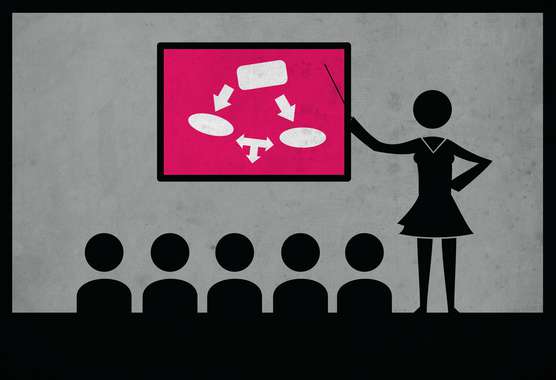
As it’s usual in call centers, participants will have to be trained in order to reach our goals. They will receive a short course on how to deactivate the way call center agents are trained. Once they get the skills, they’ll call customer care centers from all over the world, seeking to strengthen a bond with teleoperators and get to know the real person behind the operator.
The goal will be to have an affective chat in order to relocate operators, give them back their identity and leave a record of this experience in a map. The sum of all contributions will configure a global cartography of delocalized communication.
What kind of communication approach do you use?
We intend to dearticulate mechanisms with which corporations reduce communication into a mere exchange of information, allways useful to their own intrests. We try to generate bonds of affection by parasitizing technologies of control. We try to turn this technologies of control into technologies of resistance.
What are in your opinion concrete benefits to the society because of your communication?
While CCE! is a micro scale intervention, it calls to reflect on topics that are sensitive in our society, such as precarious work, virtualization in contemporary communications, role of youth in work global market, international division of labor, etc.
What did you personally learn from creating your submitted work?
Generally we consider ourselves critical with Capitalism, but day to day we reproduce, without noticing it, alienating relations. And it’s never that easy to change the way in which stand in front of others.
Why is your work, GOOD communication WORK?
We believe that every attempt to generate ties of affection, such as to evade the structures of control imposed by corporations, are positives to society.
Where and how do you intent do implement your work?
The project can be implemented in public events (exhibitions, meetings, fairs, partys, etc) or in private space such as home or at work.
We have designed a booth for placing it in public spaces. It had been shown at an art exhibition last year. We’re producing short videos in order to spread them virally through the Internet.
Did your intervention had an effect on other Media. If yes, describe the effect? (Has other media reported on it- how? Were you able to change other media with your work- how?)
Some mainstream newspapers have published articles about our project, some of them was pretty good. But journalists and editors usually lack to understand this kind of project which walks in the edge of art and activism.
Curators Comments
Alain Bieber
You mentioned some really important problems in your description: Today we see no contradiction anymore in voting the Green Party and flying around the globe with Low Cost Airlines and we´re lucky to get the most cheapest computer in a discount market with which we then participate in a DDoS-Attack for an activist movement. Most people are aware that call centers are an exploitation and new way of virtual imperialism - but accept it to save some money. In France it´s really extreme - almost every (even small) enterprise has an outsourced call center, I spend hours in these lines, mostly getting completely frustrated. Perhaps this is one reason why I must vote for your project. I also think that an very important and interesting issue not enough treated in art & activism. And the concept integrates very well the activist ABC inspired by Ju-Jitsu, which aims not to neutralize power with power but absorb an attack and convert that energy to the opponent’s own detriment. But I also like that you do not push it to the limit and stay social in your approach by saying: "Agents are trained so that calls are short and dynamic, or else, they will be penalized. Once you stablish a connection don’t extend the call for more than five minutes." And I have to admit, too: I already loved your "Radical ATM Service" - and it´s nice to see a similar fun & entertaining & playful approach.

Alana Hunt
This is a beautiful disturbance working to highlight the undercurrents that lay beneath the mechanized nature of so many social transactions in our daily lives. The tactical use of parasitic media forms, for pedagogic and practical purposes, has been put together in a wonderfully cheeky and accessible way.
In terms of making us conscious of the people whose voices we encounter at the end of a 1800-number, this work attempts to personalize and make real what are otherwise a series of distant and alienated relations. But one also needs to ask difficult questions. And so I wonder, in the context that you are working what does it mean to “personalize” and to “make real”, and how can such things be pushed to their fullest and most meaningful potential?
Unfortunately the "sharing" section of the website was playing up when I tried to access the work online so I was unable to view the information the project has gathered – what I imagine could be an ongoing collection of personal stories and conversations that might even allude to the nuanced, changing tone of a voice as it shifts from being mechanized and alienated to personalized and somewhat intimate.
Was it possible to get to the "deeper issues" including people’s opinions about their choice of career and work place? Or did the material remain mostly at the level of statistics? Did you meet some people who enjoyed their work and were proud of their career choices? And what do opinions like this say about the premise of alienation that the work starts from?
It is of course important to understand the alienating undercurrents of call centres and other similar corporate set ups, and to find our own ways to warm these otherwise cold experiences. Yet I wonder, how this work can function to its fullest? On the one hand we have a compilation of statistics and stories and on the other hand an attempt to establish what you have described as ‘ties of affection’. Yet what necessities our ties, what makes us affectionate and what creates a community? In what ways did the workers themselves find it relevant or meaningful to engage in the more personalized mode of conversation you were seeking to establish through the project?
There can never be an overarching formula for meaningful participatory adventures of this sort, but there is great potential to explore how practices like this can be deepened in a mutual and reciprocal fashion.
I look forward to seeing this work accumulate over time.

Aaron Gach
This is a clever and amusing interface for addressing the political and social dynamics inherent in corporate call centers. The video/animation is well put together, as is the website and the installation; however, I was disappointed to see that only a handful of calls have been made.
I am all in favor of projects that seek to liberate others from alienating labor, but I wonder if there isn't something inherent in the structure of this project that ultimately feels too much like work for the participants as well. Is it possible to incorporate a more dynamic social aspect into this project? Would this project work better as a phone bank, of sorts; i.e., lots of people hanging out together making calls rather than just one person at a computer?
Having known call center employees, I am sure that some of them would greatly enjoy receiving a call from the Call Center Experience.